I bought my first house and had to figure out what I actually wanted my home to feel like. Not look like. Feel like. That question is what led me, completely by accident, to hygge (pronounced hoo-gah), the Danish word for a kind of cozy, intentional living.
I’d wanted a cozy house for as long as I could remember. I just hadn’t known there was a whole philosophy built around it, one that treats slowing down and coming home to yourself as seriously as any decor trend treats a color palette. Hygge isn’t a trend, though. It’s a lifestyle, a way of connecting with your life and your space.
That’s really what this guide is about: not a checklist of candles and blankets (though we’ll get to those), but the intentional, sensory, occasionally messy practice of building a home, and a life, that actually feels like yours.
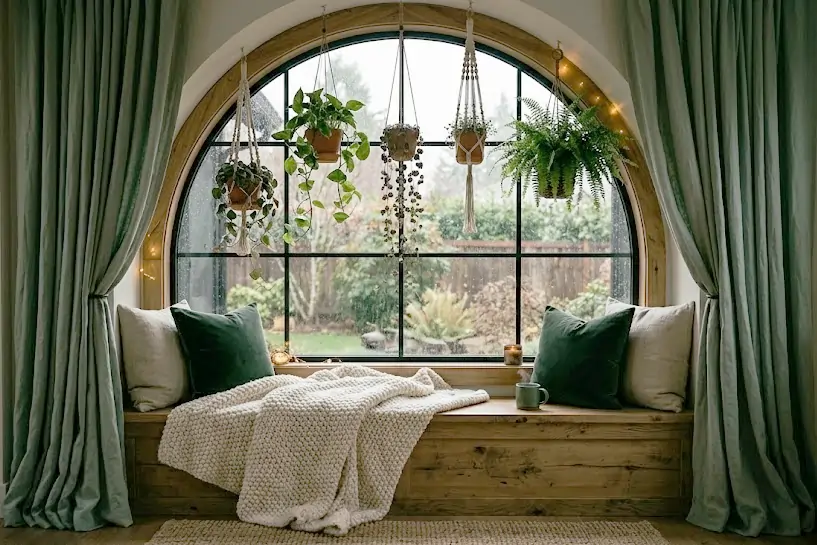
What the Hygge Lifestyle Actually Means
Hygge traces back to a Norwegian word for well-being, and it settled into Danish culture centuries ago. Denmark consistently ranks among the happiest countries in the world, and plenty of researchers point to hygge as part of the reason why.
Louisa Thomsen Brits, who wrote an entire book on the subject, describes hygge as a quality of presence and togetherness, a daily practice more concerned with contentment than with chasing happiness itself. That distinction matters, because hygge isn’t a mood you go looking for so much as a way of paying attention to what’s already good.
Here’s where I’ll push back a little on how hygge usually gets explained, because after redecorating an entire house around this concept, I’ve landed on something more specific: hygge is not minimalism with candles. Minimalism is a formula, fewer things, cleaner lines, a rule you can follow with a donation bin. Hygge is closer to an energy. A room doesn’t need to be empty to be hygge. It needs to be collected. It needs to feel like yours, full of things that carry good memories instead of just good design.
This is also why hygge translates so unevenly across languages. English doesn’t have a single word for it, and most attempts (coziness, comfort, contentment) only capture a slice. The closest I’ve come to explaining it to a skeptical friend is this: hygge is what’s left once you stop performing your home for other people and start actually living in it.
People often ask if hygge is just Danish for “cozy.” Not exactly. Cozy describes a feeling a space gives you. Hygge describes a practice, something you do on purpose, again and again, until it becomes how you naturally live rather than an occasional treat.
What Hygge Feels Like in My Home
The Ritual That Anchors My Evenings
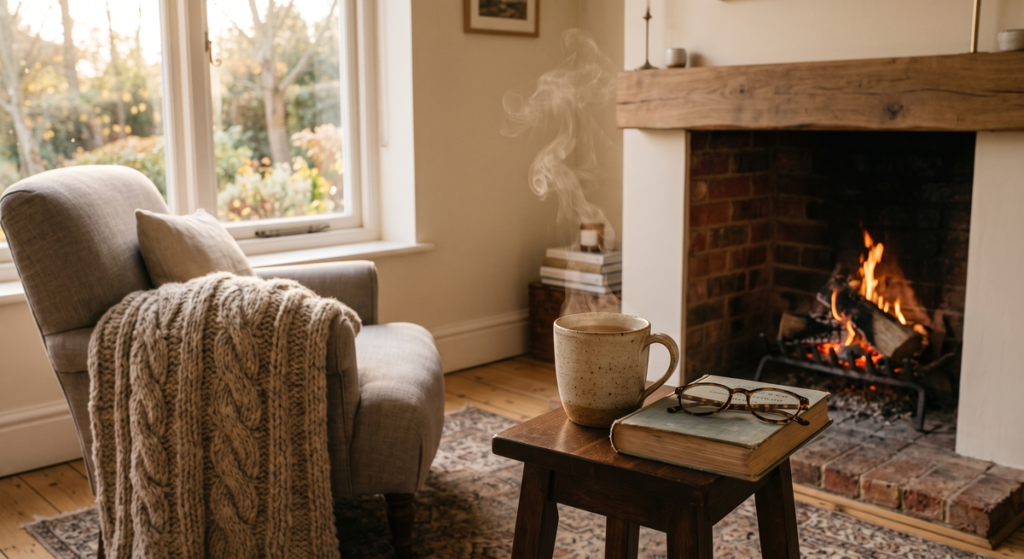
Ask me what hygge looks like in practice and I won’t describe a Pinterest board. I’ll describe a chair by the fireplace and a cup of tea, not served in the everyday mug but in the one that’s a little more special, poured a little more slowly, holding tea treated like something valuable, sipped with gratitude and contentment. That detail matters more than it should. There’s something about drinking from something beautiful that tells your nervous system this moment counts, that your life is worth savoring instead of just getting through.
Do you have a version of this? A specific mug, a specific chair, a specific fifteen minutes that belongs only to you? If not, that’s the whole invitation of hygge in one sentence: find it, then protect it.
For me it usually lands somewhere between six and seven in the evening, after the workday has technically ended but before whatever’s next has started. The kettle going. The house settling into itself before dinner. Ten minutes, sometimes twenty, that belong to nobody but me.
The Blanket (and the Cat Who Claims It)
A few years ago I bought a wool blanket while traveling through South America, hand-woven, heavier than anything you’d find at a home goods store, with a beautiful pattern and colors that make me feel fulfilled and happy. Every time I pull it over my lap, my cat, Katara, appears out of nowhere and claims the other half. Some nights she seems to understand what that blanket means before I do: slow down, we’re staying in.
That’s hygge too, honestly. Not the blanket itself, but the fact that an ordinary object has become a reliable little signal for rest, for disconnecting from technology and connecting with the real world. Photos work the same way. I keep frames of the people I love and the places I’ve traveled somewhere I’ll actually see them, not tucked in a drawer. A home collected around real memories does something a perfectly styled one can’t: it reminds you, at a glance, that your life has already been good in specific, particular ways.
Hygge as Self-Care, Not Indulgence
There’s a version of self-care that gets marketed as extra, something you have to justify. Hygge treats it as maintenance instead. On the days I need a little space to myself, that might mean a bold color of nail polish, music that isn’t background noise but the actual point, and a candle lit for no reason other than that I like the smell. None of that fixes anything, and it doesn’t need to. It’s a signal, the same as the mug and the blanket, telling your body that you’re allowed to take up a little room in your own life.
The Hobby I Didn’t See Coming
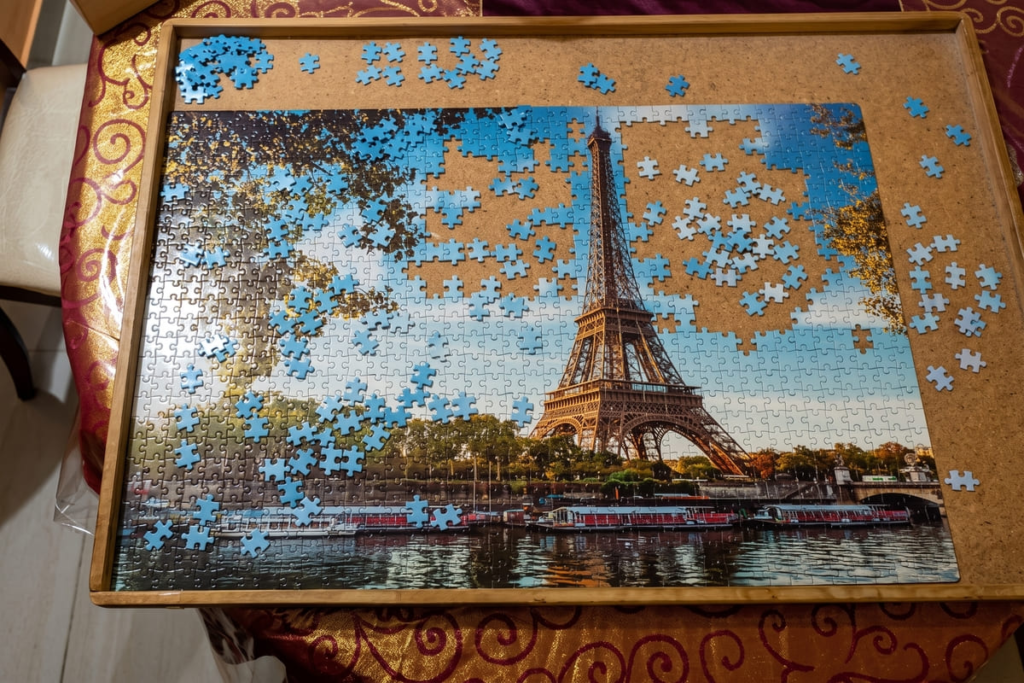
Last winter I started doing jigsaw puzzles, mostly by accident, and it turned into one of the better slow-living habits I’ve picked up in years. It takes over the table and makes an intentional mess, and piece by piece you build something great instead of clearing it right away. No screen required. Friends and family can pull up a chair, help for ten minutes or an hour, and somehow conversation flows easier over a half-finished puzzle and a mug of cocoa than it does sitting across a table with nothing to do with your hands.
If you’re looking for one low-cost way to bring the hygge lifestyle into your own home this season, start here. It’s inexpensive, it’s screen-free, and it turns “come over” into something with a built-in activity instead of pressure to entertain.
Hygge at Your Desk
You don’t need a fireplace and a free Saturday to bring any of this into a workday. A small plant on your desk, real daylight instead of fluorescent overhead light when you can manage it, a mug you actually like instead of whatever’s clean, these do more for how a workday feels than most productivity advice. Even a real lunch break, away from a screen, with something you actually want to eat, counts. Hygge doesn’t clock out just because you did.
Why Hygge Wellness Actually Works
Hygge wellness isn’t just a nice feeling, it’s backed by what we understand about the nervous system. Environments and rituals that feel warm and safe help the body shift out of fight-or-flight and into rest-and-digest, and over time that has real effects on mental health, stress levels, and overall well-being. If you’re looking for another gentle way to support that same shift, yoga for stress relief is a natural next read. Movement and breath work do a lot of the same job hygge does, just through the body instead of the room around it.
The Happiness Research Institute in Copenhagen, which studies slower, more intentional lifestyles, keeps landing on the same three benefits:
- Less stress, through sensory comfort and simply slowing down
- Deeper connection, through togetherness, whether that’s hosting people or sitting beside someone you love
- More presence, the simple, undervalued act of actually being where you are instead of already thinking about where you need to be next
Hygge Beyond Autumn
Hygge gets typecast as a winter thing: candles, wool socks, hot drinks by a window. The hygge lifestyle is really available in every season. Spring hygge is open windows and fresh flowers on the table. Summer is slow mornings on a porch and lemonade sweating onto a coaster. Winter is the deliberate warmth you build when the world outside goes gray. The formula changes. The feeling doesn’t.
If you only reach for hygge in the last few months of the year, you’re missing most of what it can offer. A hot mug on a cold morning is easy. The real practice is finding that same slow, attentive feeling on an ordinary Tuesday in July, when nothing about the weather is asking you to slow down.
Simple Ways to Start the Hygge Lifestyle Today
If you’re not sure where to begin, start smaller than you think you need to:
- Swap one harsh overhead light for a lamp or a candle this week
- Pick one mug or glass that’s just for you, and actually use it
- Keep one surface in your home clear of everything except what genuinely makes you happy to look at
- Set aside twenty minutes with no screen, just a drink and a window
- Invite one person over for something low-effort, a puzzle, a cup of soup, nothing that requires cleaning for three days first
None of these cost much. That’s kind of the point.
You Don’t Need to Buy Anything to Start
It’s easy to read a list like that and assume hygge means a shopping trip, a new candle, a new blanket, a new mug. And that’s actually the best way to do it, shopping intentionally instead of emotionally, choosing whatever genuinely fulfills you over whatever trend happens to be passing through. But the actual entry point is free: turn off one light and light a candle instead. Sit somewhere you don’t normally sit. Call a friend instead of scrolling past their name. Cook one meal slowly instead of standing at the counter eating over the sink. The feeling comes first. The objects, if you want them, come later, and only the ones that genuinely earn a place in your home.
The Real Point Isn’t the Aesthetic
Here’s what I’d want you to take from all of this, more than any specific ritual: hygge, at its core, is about romanticizing your own life instead of measuring it against someone else’s pace. It’s connection, to your home, your people, your pets, the things actually within reach of you, instead of moving through your days a little disconnected from everything, including yourself.
A cup of tea by a window. A blanket a cat insists on sharing. A puzzle that turns a Tuesday night into something with friends in it. None of that is small once you stop treating it as small. These moments are as good as you let them be. There’s no comparison to make, no one else’s timeline to measure yours against. Your life is what you actually enjoy, and hygge is just a word for paying attention to that on purpose.
I think about this every time I catch myself scrolling through someone else’s version of a perfect life and feeling behind in mine. Hygge is the antidote to that particular flavor of exhaustion. It doesn’t ask you to build a more impressive life. It asks you to notice the one you already have.
So start with one thing. Light the candle tonight. Use the good mug tomorrow morning. Pull out a puzzle this weekend and see who shows up to help.
What’s one day-to-day object in your home that makes your life feel a little more like yours?