There’s something satisfying about opening a drawer and finding everything exactly where it should be, the same feeling you get walking into a well-organized store where everything’s sorted by color, size, and style, easy to spot and ready to try on. If your current laundry routine usually ends with a pile on the chair or a drawer you have to force shut, this post is for you.
Folding clothes is, if I’m honest, one of the chores I procrastinate on the most. But done with a little intention, it becomes one of those small rituals that makes your everyday life feel more put-together. And the good news? You don’t need a perfectly curated closet or a lot of time. You just need a few simple techniques and a new way of looking at the process.
Should You Fold Clothes or Hang Them? Knowing the Difference Changes Everything
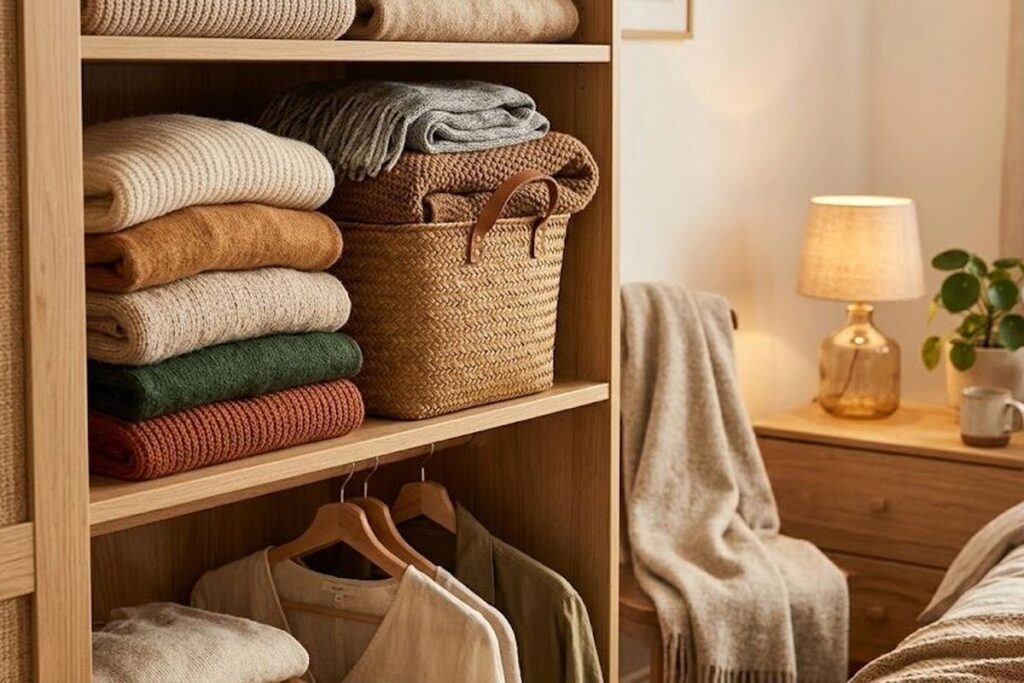
One of the most common wardrobe questions is whether to fold clothes or hang them. The answer: it depends on the fabric and the garment. Knowing when to hang versus fold is the secret to a wardrobe that stays wrinkle-free and easy to navigate.
Hang these:
While folding clothes is a great way to save space, some items are better off on a hanger to maintain their shape.
- Blazers, structured jackets, and suits
- Dress pants and trousers
- Silk blouses and delicate tops
- Anything that creases easily or loses its shape when folded
Fold these:
For everything else, a consistent method for folding clothes ensures your knits and basics stay in great shape. Stick to these items for your dresser or shelves:
- Knitwear and sweaters (hanging stretches them out over time)
- Denim and casual pants
- T-shirts, loungewear, and casual basics
- Workout clothes and underwear
A simple rule of thumb: if it has structure, hang it. If it has stretch, fold it. Getting this right protects your clothes and makes your wardrobe feel more intuitive to use.
This has happened to me more than once. My sweaters get saggy and stretched out from hanging, and I’ve gotten actual hanger-shaped bumps on the shoulders of pieces I loved. Hung clothes can also tangle with zippers and hooks nearby, which has torn more than one item over the years. The worst case was a cashmere sweater that ended up with small holes, likely moths, though it was hard to catch early since it was hanging in a dark closet packed tight with other clothes. Folded and stored somewhere I could actually see it, I probably would have noticed in time to save it.
Different Ways to Fold Clothes (and When to Use Each)
Here are the most useful different ways to fold clothes, depending on your storage setup and your personal preferences.
The Flat Fold
The classic folding method. Lay the garment flat, fold in the sides, then fold in thirds or halves. Best for shelves where items are stacked. Simple and reliable for basics like pajamas, jeans, and casual tops.
The Retail Fold
Ever noticed how clothes in a store look so crisp and neat? That’s the retail-style fold, and it’s easier than it looks. Lay the item face-down, fold in one side at a slight angle, then fold the sleeve back. Flip and fold the bottom up in clean thirds. The result is a smooth, display-ready rectangle. It’s especially satisfying for T-shirts and gives your shelves a polished, boutique feel.
The File Fold (Vertical Storage)
Popularized by organizing experts, this method involves folding clothes into a compact rectangle and standing them upright, like files in a drawer. The game-changing benefit: you can see every item at once without disturbing the others. It works beautifully for T-shirts, jeans, and gym clothes.
Marie Kondo really popularized this way of folding. It’s creative, and it does take practice to get right. Honestly, I tried it and didn’t have the patience to get every single piece as precise as she does; it’s a lot of upkeep. I’ve found that “nearly folded” is good enough for me, especially with a smaller, more minimalist closet where everything’s easy to reach either way.
How to Fold Clothes Without Wrinkles
Wrinkles are usually a sign of one of three things: folding while still damp, folding incorrectly, or leaving folded clothes in a pile too long. Here’s how to fold clothes without wrinkles:
- Fold while slightly warm, straight from the dryer or off the drying rack before they fully cool. Fabric is more cooperative when it still holds a little warmth.
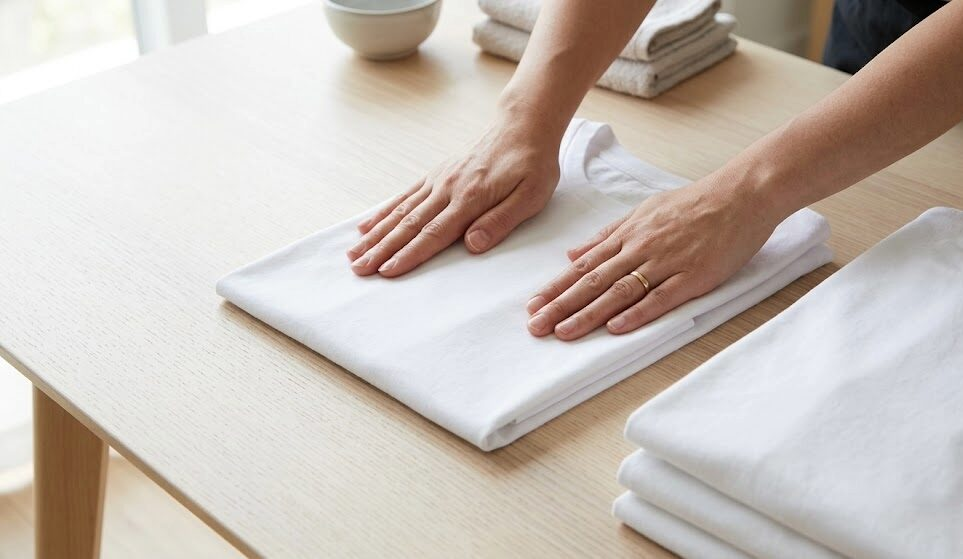
- Smooth as you go. Run your hand along each fold to press out any creases before moving to the next step.
- Don’t overfill drawers. Wrinkles often come from compression. Give your clothes a little room to breathe.
- Store delicates flat. Silk, linen, and lightweight fabrics wrinkle most easily. Flat storage or a single gentle fold keeps them smoother.
For pieces that crease no matter what, linen pants, cotton dresses, a light press with a cool iron before folding makes a real difference.
How to Fold Clothes Easily: Build a Rhythm, Not a Chore
The secret to making folding feel easy is finding a way to get your clothes organized as soon as the laundry is done, so you finish the whole task of clothing maintenance in one go. Those extra five minutes putting things away make a real difference later in the week. Here’s how to fold clothes easily and actually follow through:
Fold straight out of the dryer. I do this whenever I can. Pulling everything out and folding it right there, before it hits a basket unfolded, means it’s already wrinkle-free and ready to put away, instead of turning into a pile you have to deal with twice.
Pick a spot that works for your life. For me, that’s the couch. Sundays are laundry day, and I fold while I’ve got a show on in the background, often while I’m also cooking or getting things ready for the week ahead. It doesn’t need a dedicated, silent corner to count as intentional. It just needs to actually happen.
Put it away immediately. The pile on the chair exists because we fold and then abandon the task. Make a rule: fold and put away in the same sitting. It takes five extra minutes and saves you from re-folding tomorrow.
Let it double as downtime. Folding doesn’t have to be a separate chore squeezed in somewhere. Pairing it with a show or a podcast turns it into part of your wind-down instead of one more task fighting for your attention.
How to Fold and Put Away Clothes: A Simple System That Sticks
Most wardrobes get messy for the same reason: we put in the time for the laundry and the folding, then get a little careless when it actually comes to putting things away. Here’s a gentle approach to folding clothes and putting them away in a way that actually lasts:
Assign a home to everything. Each category of clothing should have a consistent place. When you always know where something lives, putting it away becomes second nature.
Group by use, not just category. Keep your most-worn pieces at eye level and easy reach. Reserve higher shelves or the back of drawers for seasonal or occasional items.
Do a quarterly refresh. Four times a year, pull everything out, refold, and reassess. Donate what no longer fits or no longer brings you joy. A wardrobe with breathing room is so much easier to maintain.
Keep like with like. All your loungewear together. All your workout clothes in one drawer. When everything has a category, the system maintains itself.
Do a quick weekly touch-up. If a few items end up out of place after a week, just take a few minutes to reorganize or put them back where they belong. Small touch-ups like this keep your closet organized for longer.
Making Space When Your Closet Wasn’t Built for Folding
Most closets are designed almost entirely around hanging space, which is a real problem if you’d rather fold. A few ways to carve out room without a renovation:
- Add shelf dividers or stackable bins to whatever shelf space you already have. Even one shelf holds several folded categories once it’s divided instead of left as one open surface.
- Use the closet floor. A low, open-top bin or woven basket is enough for folded loungewear or off-season pieces that don’t need prime shelf space.
- Borrow drawer space from elsewhere in the room. A dresser doesn’t have to sit inside the closet itself to serve it. My nightstand, for example, holds my pajamas. It’s nowhere near my closet, but it works better there than fighting for shelf space where the closet actually is.
- Fold what you’d normally hang. Shorts, leggings, and many skirts fold perfectly well and take up a fraction of the hanging space they’d otherwise need. A flat fold or file fold works for all three, and it frees up your rod for pieces that actually need it, like blazers or dresses.
The Everyday Benefits of a Well-Folded Wardrobe
Beyond the practical, there’s something calming about a tidy wardrobe, and it’s not just a feeling. Researchers at UCLA found that women who described their homes as cluttered or unfinished had measurably higher stress hormone levels throughout the day than women who described their homes as restful, according to a study published in Personality and Social Psychology Bulletin. A closet is a small piece of that picture, but it’s one you interact with every single morning, which makes it a reasonable place to start.
When your wardrobe drawers are organized and the shelves are tidy, getting dressed in the morning becomes effortless. You spend less time searching, less time re-ironing, less time putting your outfits together, and less time buying replacements for things you already own.
My mornings are so much easier when my wardrobe is organized and tidy. There’s no more digging through piles of clothes or realizing too late that what I want to wear is dirty or wrinkled. Taking the time to fold and arrange my clothes has made a real difference in how quickly and easily I get dressed.
A Soft Place to Start
You don’t need to spend hours organizing your wardrobe this weekend. Start with one drawer. Pick one folding method, maybe the file fold for your T-shirts, and spend twenty minutes on it. Put on something you enjoy watching or listening to and let the process be more enjoyable.
As you get the hang of folding with intention, you’re doing more than tidying a drawer. You’re gifting yourself a lovely space that’s easy to navigate, a few extra quiet minutes each morning by cutting down the time you spent putting together and organizing your outfits, and a longer life for the garments you already love.
Tell me in the comments: what’s your biggest laundry struggle, the folding, the putting away, or something else entirely?