People say “Sunday Fun-day,” but I eventually realized some of my Sundays were anything but fun. While the days were long and the afternoons were warm, I’d spend those beautiful hours stuck inside with my rubber gloves on, staring down an endless to-do list that had been accumulating since Monday. I was desperate for a low effort cleaning routine, a way to reclaim my time and focus on creating memories instead of just managing messes.
What made it worse was that my to-do list never felt complete. I’d finally get my house sparkling, only for it to fall apart again by Tuesday. The dishes, the counters, the clutter, it was a relentless cycle.
Here is what I eventually figured out: I didn’t have a cleaning problem, I had a systems problem. Once I stopped trying to clean harder and started building a smarter, low effort cleaning routine, everything got easier. My home stayed organized and clean, and I reclaimed my weekends for the things I love.
This post is the foundation, a full framework for building a home that requires less of you. It’s about creating rhythms that handle the mess before it ever has the chance to snowball.
Why Traditional Advice Fails: A Cleaning Routine for Busy Professionals
Here’s the thing no one says out loud: most home cleaning advice is designed for people who either truly enjoy cleaning, or have large pockets of free time to stay consistently on top of it. If you’re a busy professional with a social life, and maybe a partner, a pet, or both, that advice just doesn’t fit your life. The traditional model pushes extensive cleaning sessions, rigid weekly chore charts, and a standard of cleanliness that requires constant manual effort to maintain.
With the mental load of a full-time job, my energy was usually at zero by Friday. The last thing I wanted was to come home and essentially clock into a second job that involved scrubbing things.
A few years ago, a close friend started bringing me fridge magnets about hating chores whenever she traveled. It was funny, but it was also a pretty accurate reflection of the truth: my total lack of any real plan was failing me, and I couldn’t stop complaining about it.
A Practical Perspective: Research highlighted by UN Women shows that women often spend significantly more time on unpaid care and domestic work than men, in some regions, up to five times more. You can read more about this global time-use survey here.
This imbalance makes establishing low effort cleaning routines not just a luxury, but a necessity for busy women to maintain their professional success and personal peace.
The Philosophy: Maintenance Over Recovery
Before I walk you through exactly what I do, I want you to sit with this idea for a moment. There is a massive difference between wiping down a bathroom sink for thirty seconds every other day and spending forty-five minutes scrubbing hardened buildup three weeks later. Same end result, completely different experience. The first one barely registers. The second one ruins an evening.
A low effort routine isn’t about lowering your standards. It’s about keeping the baseline just high enough that it never becomes a big event.
The other piece of this is friction. When cleaning supplies are buried under the sink behind seventeen other things, cleaning feels inconvenient and you avoid it. When a container of wipes is right there, you use it without thinking. When your vacuum lives in a closet that takes effort to open, it stays there. When it’s lightweight and easy to grab, you run it in five minutes on a Tuesday. The goal is to remove every possible reason to put it off.
Step One: The Reset Routine (Start Here If You’re Overwhelmed)
If your home is already feeling like it has the upper hand, start here. Not with a deep clean. Not with a total reorganization. Just a reset routine.
The distinction matters because trying to do everything at once leads to burnout halfway through. A reset routine is smaller. It’s just getting back to a place where you can breathe.
The 20-minute daily tidy up. Set a timer, morning before work, or right after dinner, and spend twenty minutes on one focused space. Not cleaning everything, just returning things to where they belong. One room, completed. Repeat tomorrow.
The “Bothers Me Most” list. Write down the five specific messes that affect your mood most when you see them. For me it was dishes in the sink, cluttered counters, unfolded laundry, cat litter near the entrance, and piles of papers and mail. Those become your priority. Clean the things that drain you visually first, the emotional relief makes everything else easier.
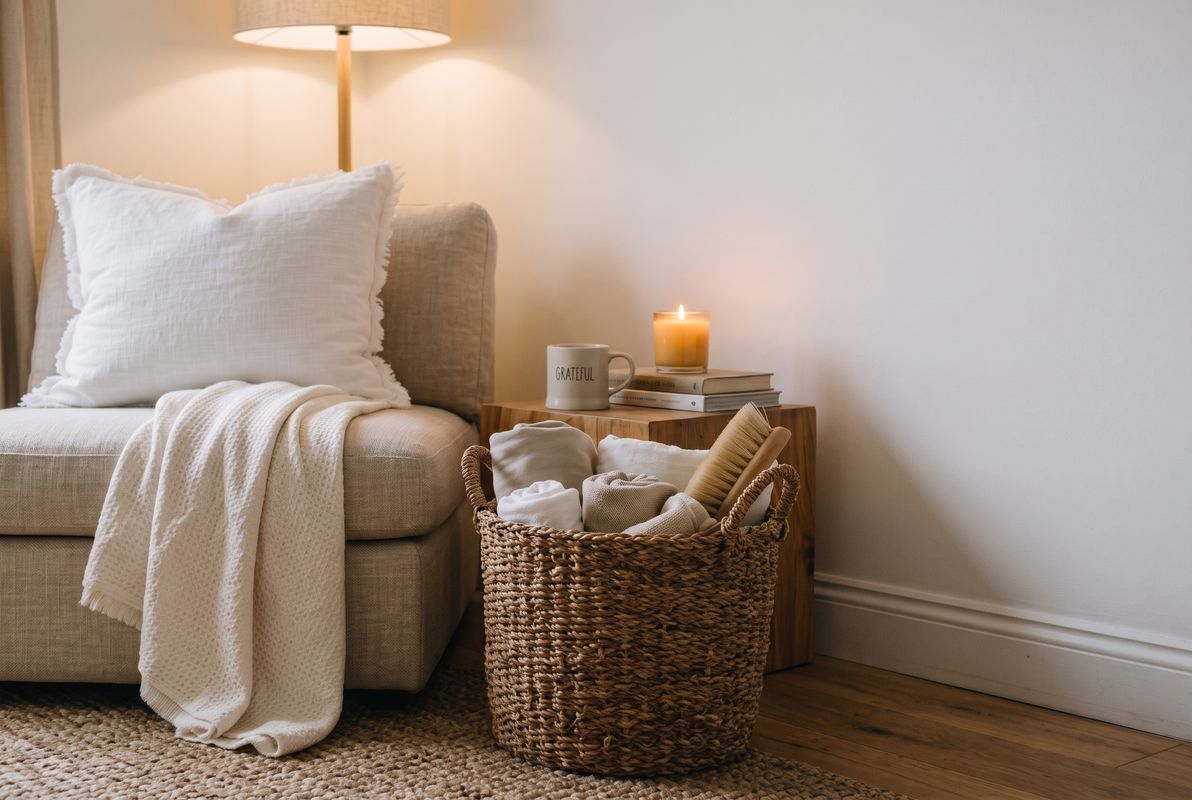
The reset basket. This one is so simple it sounds too easy, but it changed my home more than almost anything. I keep a small basket in the main living spaces. Throughout the day, anything that doesn’t belong in that room gets dropped in. In the evening, I spend about five minutes returning everything to its actual home. This reset routine interrupts the drift before it turns into chaos by Thursday.
Decluttering: The Uncomfortable Truth About Low Effort Cleaning Routines
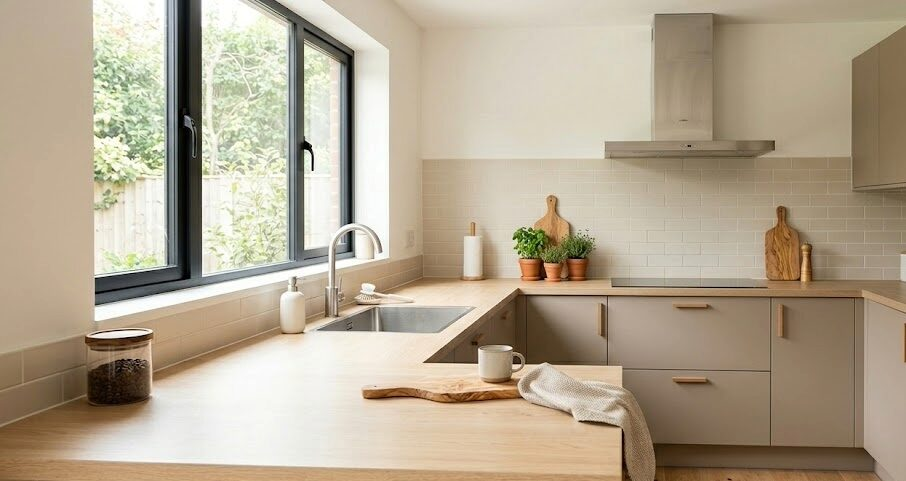
A lot of people don’t actually have a cleaning problem. They have a too-many-things problem. Every extra item on a surface collects dust. Every additional blanket needs folding. Every mug that doesn’t have a clear home eventually ends up in the sink. When I started leaning into a more minimal home aesthetic, cleaning became dramatically easier, not because I was more disciplined, but because there was physically less to manage.
You don’t have to go full minimalist. Even removing 20% of unnecessary items from one room changes how manageable it feels. Clear surfaces create visual calm. And visual calm is the entire point.
The Four Pillars of an Effortless Home
Once the foundation is there, everything else builds around four pillars. I think of these as the invisible structure that keeps my home consistent without requiring a lot of me.
The Visual: Design Out the Mess
Your home can be technically clean and still feel chaotic. Visual clutter, crowded countertops, too many exposed items, things without a home, overstimulates the brain throughout the day without you realizing why.
I started prioritizing a calmer visual environment: countertops mostly clear, appliances stored when not in use, everything with a dedicated spot. The calmer the room looked, the calmer I felt. It turns out this isn’t just aesthetic preference, reducing visual noise has a measurable effect on cortisol levels. A calmer space is a calmer nervous system.
The Invisible: Your Low Effort Cleaning Routine in Practice
This is the heart of everything. Instead of waiting until the mess became unbearable, I assigned small recurring tasks a slot in the week. Nothing takes long because nothing has been neglected long enough to become hard.
Here’s a framework close to what I actually use, adjust the specific days to fit your own week:
Daily (10 minutes total):
- Wipe kitchen counters
- Return items to their homes
- Run the dishwasher before bed
- Quick bathroom surface wipe
Weekly (one task per day, never more):
- Monday: Bathrooms
- Tuesday: Vacuum
- Wednesday: Mop and floors
- Thursday: Laundry reset
- Friday: Change linens
- Saturday: Light catch-up if needed
- Sunday: Completely off
Monthly (rotating, one area at a time):
- Oven, inside the fridge, baseboards, windows, each gets a turn. You’re never doing all of it at once.
The simplicity is why something like this works. Complicated setups collapse under the weight of a stressful week. Simple ones survive.
The Intuitive: Let Technology Do What You Shouldn’t Have To
My robot vacuum runs every morning while I’m at work, so by the time I finish work, the floors are already done. Automatic reminders help me restock household essentials before running out. My cats, Sokka and Katara, have a Litter Robot that handles one more recurring responsibility without me having to hold it in my head.
These feel like minor things individually. Together, they eliminate hundreds of tiny decisions every month. And it’s often those tiny decisions, not the big chores, that exhaust people most.
The Sensory: Creating an Evening Reset Routine
This pillar is the easiest to overlook and probably the most impactful for your overall sense of peace. Your home should actively help your nervous system downshift at the end of the day. Without a deliberate transition, you can be physically home while your brain is still sitting at your desk.
For me, that transition looks like changing out of work clothes immediately, lighting a candle, dimming the lights, sometimes a short walk first. Certain scents, textures, and lighting cues signal safety and rest. It’s not complicated, it’s just intentional. A sensory ritual turns a clean home from a backdrop into an actual sanctuary. If you want to lean further into this feeling, check out my complete guide to the hygge lifestyle.
Laundry Without the Dread
Laundry deserves its own moment because it was the thing I resisted most and the thing that changed most dramatically when I adjusted my approach.
The shift: I stopped treating laundry as a single all-or-nothing event. Sunday is still my main laundry day, but if the pile’s grown bigger than usual during the week, I’ll run an extra load partway through instead of letting it all stack up until Sunday.
Smaller, more frequent loads feel psychologically lighter and, crucially, are easier to finish completely. A load that sits in the dryer for four days isn’t saving time, it’s creating the dreaded laundry chair.
I also simplified where things land once they’re clean. Pajamas go straight into my nightstand instead of the dresser, since that’s actually where I reach for them. Workout clothes go into the closet with everything else, no separate bins or labels needed, just a consistent home for each category so I’m never hunting for anything.
Hooks help. Consistent homes for things help. Tiny decisions made in advance help more than motivation ever will.
Splitting Chores Fairly (This One Matters a Lot)
When my partner and I moved in together, we had a few honest conversations about the fair division of household labor and splitting chores fairly. Like most couples, we both initially felt like the other person wasn’t pulling their weight. The issue wasn’t actually effort, it was that the mental load was invisible, and it wasn’t falling equally. It’s a strangely common conversation, my friends and I have compared notes on the exact same struggle more than once.
One person becomes the default household project manager. They track what’s been done, what needs doing, what’s running low. That role is exhausting and often completely unacknowledged.
We sat down and listed every recurring responsibility, cat care, groceries, financial admin, cleaning, cooking, taking out the bins, and divided based on honest preference and energy. I don’t mind certain meal prep. My partner handles things I find draining. Once everything was written down and clearly owned, a lot of the resentment evaporated almost immediately.
What’s worked for us is fairly simple: some of it lives on my Google Calendar, and my partner keeps a more intuitive sense of what needs doing on which day. It’s less structured than a dedicated app, but it’s actually the version we’ve stuck with. The goal isn’t a perfect 50/50 split, or the fanciest tracking method, it’s a split you both actually agreed to and a way of tracking it that you’ll actually use.
What Actually Changed
The biggest shift I noticed wasn’t actually the cleaner house. It was waking up on Sunday morning and not immediately feeling behind.
That low-level guilt, the constant reminders in the back of my mind of everything I hadn’t done, was gone. My home stopped feeling like another responsibility and started feeling like the soft landing it was always supposed to be.
A solid low effort cleaning routine doesn’t make you better at cleaning. It protects your energy. It creates space for slow mornings, long dinners, spontaneous plans, and evenings that are actually yours. Perfection was never the point. Peace was always the point.
Start With One Thing
You don’t need to overhaul everything at once. Pick one thing from this post and implement it this week:
- Do the reset basket. One basket per main room, five minutes each evening.
- Write your “Bothers Me Most” list and clean those five things first.
- Have the chore conversation with whoever you share your space with, make it a real conversation, not an assumption.
- Start the daily 10-minute reset routine tomorrow morning.
- Order a robot vacuum and schedule it for your work hours.
One small shift in the foundation changes the whole feel of the week. And once you feel how much lighter that is, the next cleaning routine comes naturally.
What’s the one recurring mess in your home that always seems to win? I’d love to hear about it in the comments.