I used to be great at looking like I had my life together. Showered, showing up every day at work, coffee in hand, everything on my to-do list checked off. On paper, I was doing fine. What nobody could see, myself included, was that I was running the whole thing on autopilot, moving through my days without actually enjoying them. If that sounds familiar, if you’re tired, burnt out, or just running on fumes more days than you’d like to admit, this one’s for you.
Here’s the shift that actually worked: instead of trying to change my whole life at once, I built a mindful daily routine out of three simple systems, one for mornings, one for the middle of the day, and one for evenings. Keep reading and I’ll walk you through exactly how each one works, and how to build your own version without turning it into another thing you have to white-knuckle your way through.
I didn’t get here through willpower, and I definitely didn’t rebuild my entire life in one weekend. I got here by reinventing the way I move through my day, one small habit at a time.

What a Mindful Daily Routine Actually Looks Like
Here’s the short version before I get into it. A morning system that protects the first hour of your day. A midday system that keeps your energy from collapsing in the afternoon. And an evening system that actually lets you rest.
None of these require a gym membership, a five-step morning miracle routine, or waking up at 5am. They just require doing the same handful of things on purpose, most days, instead of letting the day happen to you.
Why Systems Beat Willpower
I used to think the problem was discipline. That if I just wanted it enough, I’d push through by sheer force, cramming my calendar with more and more things to prove it. What actually worked was almost the opposite: I stopped relying on willpower and started relying on systems.
A system means you don’t have to decide anything at 7am. You already know what happens first, second, third. The decision-making happened the night before, or the week before, when you weren’t rushed and half-awake. That’s the whole trick. Motivation can fade at any moment, but a system doesn’t, because you’re doing what’s already familiar to you.
System One: The Morning That Sets the Tone
Have you ever picked up your phone while still in bed? I did that for years, and it meant the first voice in my head every single day belonged to someone else. A headline, a notification, somebody else’s opinion, a work email, all of that even before I’d even said good morning to myself.
Here’s what changed it:
- Aim for eight hours of sleep, minimum. Everything downstream gets harder without it.
- No phone first thing. Mine doesn’t come out until I’ve had coffee and gotten dressed.
- Protect thirty minutes to an hour that belongs only to you. Shower, skincare, a short walk, getting dressed, doing your makeup if that’s your thing. It doesn’t matter what’s inside that hour. It matters that it’s yours before it belongs to anyone else.
If mornings are the hardest system to protect because your phone doubles as your alarm clock, that’s worth solving on its own. A sunrise alarm clock, like the Hatch Restore, wakes you with light instead of a screen, so the first thing you actually see is your room, not a lock screen full of notifications waiting to pull you in.
For more on building this part of your day, I wrote a whole soft morning routine post that pairs well with this one.
System Two: The Midday Reset That Keeps You From Crashing
I used to sit at my desk for hours without moving, and I didn’t clock how much that was costing me until my energy started collapsing like clockwork at 2pm, every single day, no matter how I’d slept.
Two things fixed it.
The first is walking. You don’t need a gym membership or a set of weights sitting in the corner of your room. You just need to aim for 5,000 to 7,000 steps a day, even on your rest days if you already train hard during the week. A recent meta-analysis published in JAMA Network Open, reviewing step data from more than 96,000 adults, found that people who hit at least 5,000 steps a day reported meaningfully fewer depressive symptoms than people walking less, with the benefit continuing to climb up to around 7,000 steps a day. That’s not nothing. That’s a walk around the block doing real, measurable work on your mood.
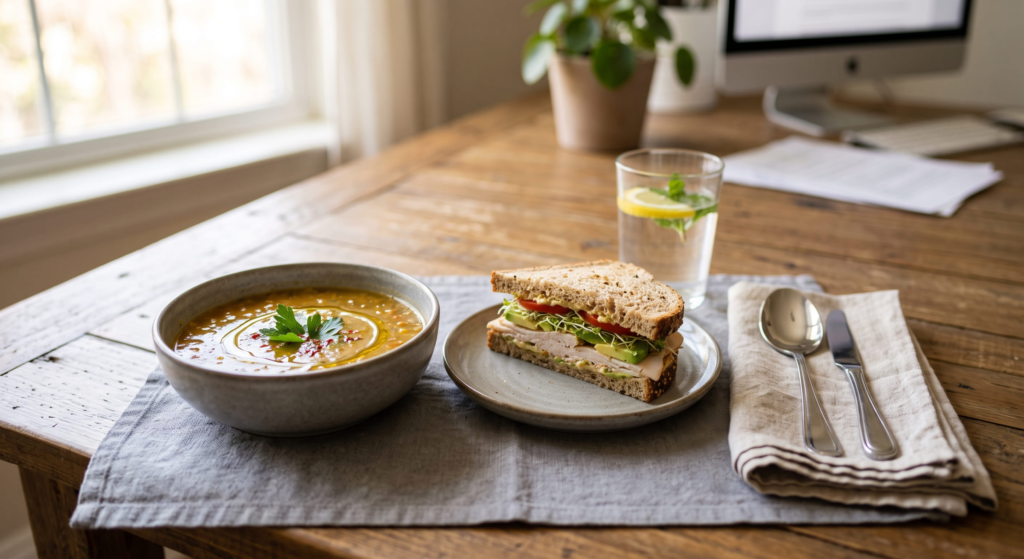
The second is lunch. When was the last time you ate a meal without a screen in front of you? I used to eat at my desk, scrolling, not really tasting anything, and then wonder why I felt unsatisfied after eating. Now I set an actual time for lunch and eat it phone-free. Fifteen minutes of just chewing, tasting, maybe some music playing instead of scrolling or checking work emails. It sounds small, but it really changes the whole middle of your day.
If your job keeps you at a desk most of the day, The Movement Nook has a few specific fixes worth pairing with your daily walk. And if lunch is the piece you keep skipping entirely, The Midday Reset goes deeper into that one habit alone.
System Three: The Evening Wind-Down
I used to feel like there was never enough time. I’d glance at my calendar minutes before something started, realize I hadn’t eaten all day, and watch the rest of the evening crumble from there. All of it traced back to the same root cause: I never prepared anything ahead of time.
So now, most nights, this is what evening looks like:
- Prep tomorrow before you close out tonight. Lay out your clothes, check your calendar, set your alarm, prep whatever you can of tomorrow’s meals.
- Around 9pm, start winding down. Load the dishwasher, put things back where they belong, take five minutes to actually look at the space and reset it.
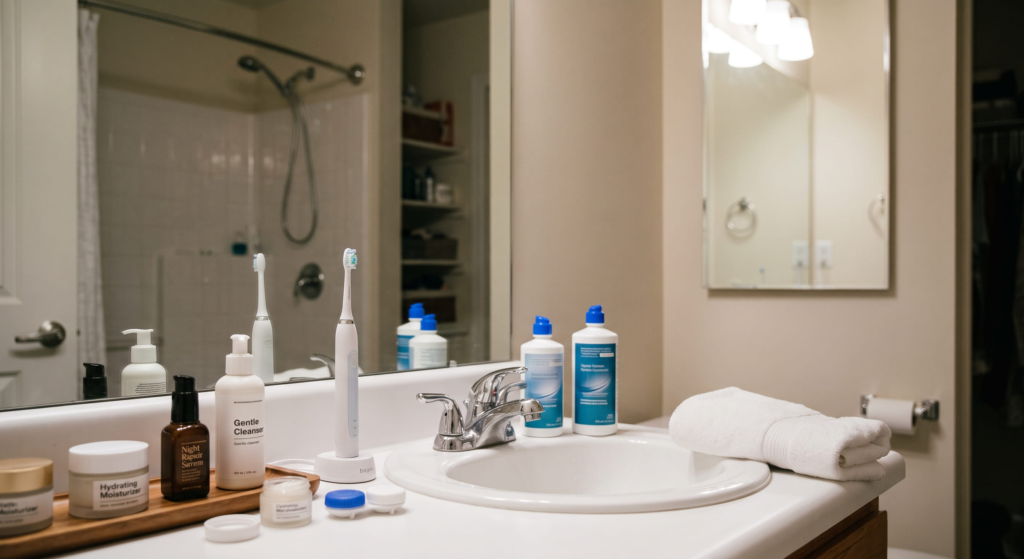
- Do a proper skincare and grooming routine. Wash your face, take out your contacts, whatever your version of this looks like. Give it a few unhurried minutes instead of rushing through it half asleep.
- Go screen-free thirty minutes before bed. If you want something to do with your hands, journaling or a few pages of a book that isn’t going to send your thoughts racing works better than a show you’ll half-watch anyway.
Do you know how long you actually go without a screen before you fall asleep most nights? For a lot of us, the answer is close to zero. Thirty minutes felt impossible the first week, but now my brain has learned what it means, and it starts settling before my head even hits the pillow.
For a shorter version of this exact wind-down, my 15-minute nighttime routine breaks it down step by step.
How to Build Your Own Version
You don’t need to adopt all three systems on the same day. That’s usually how people burn out on a new routine within a week and go back to old habits, feeling like they failed. The truth is, sustainable routines are never built overnight.
Pick the one system that’s costing you the most right now. If your mornings already feel like chaos, start there. If it’s the 2pm crash that’s wrecking your afternoons, start with the walk and the phone-free lunch. Give it a week or two before adding the next piece.
It also helps to be realistic about what your actual life looks like. A single parent’s morning system won’t look like mine, and a night-shift worker’s “morning” might technically start at 7pm. The three categories still apply. Protect the start of your day, whenever that is. Reset quickly at midday before your energy tanks. Wind down on purpose instead of just running out of steam. The order and the exact timing are yours to figure out.
Keep a simplified version ready for the hard days, too. Mine, on a genuinely rough day, is: don’t check the phone for the first ten minutes, take one short walk, wash my face before bed. That’s it. It’s not the full version, but it’s enough to keep the thread going, so I’m not starting completely from zero the next time I try to pick it back up.
Not Every Day Looks Like This
I don’t do any of this perfectly, and I want to say that outright instead of pretending otherwise. Some nights I’m out with friends and the skincare routine happens at midnight, rushed. Some weekends I’m camping, and there’s no dishwasher, no calendar-checking, none of it. Life gets in the way of systems, because that’s what life is supposed to do.
What actually matters is the consistency. Just following a routine on enough days that your body and your mood start to recognize the shape of it. That’s the point where it stops being a list of tasks and starts being something closer to how you actually live.
If you had to pick just one of these three systems to start with tomorrow, which one would actually move the needle for you?