One day, while trying to understand why it has been so difficult for me to exercise, I realized the gym is a tough place. At the first moment you walk in, you’re already holding yourself to some impossible standard, then you look around and everyone seems so fit, so sure of what they’re doing, and your motivation just plummets. That’s especially true if you’ve never had a personal trainer, someone to actually keep you accountable and show you the path. A lot of us are just out here, figuring it out on our own.
And then there’s the cost on top of it. This is where my mindful spending habits kick in: instead of signing up for expensive memberships that end up going to waste, I’d rather start small with a low-impact exercise, building habits that are actually sustainable, that fit my lifestyle, achievable but still a little challenging. I started a walking routine rather than forcing myself through another twenty-minute gym run on the treadmill. Turns out twenty minutes on foot, every single day, does more than an occasional gym session ever did.

Mindful walking is basically a way to trick your body into doing three things at once. One, you’re adding movement. Two, you’re decompressing, getting something close to a meditation session without ever having to call it that. Three, you’re outside, breathing actual air. A mindful walk is the thing that actually lets you feel every bit of ground underneath you. It’s what lets you notice the houses and the shop windows you’ve walked past a hundred times without ever really looking, because you were always rushing, or it just never occurred to you to walk that way on purpose.
Mindful Walking in the City
Vancouver helps my case, I’ll admit. It’s one of those cities where you can get almost everywhere on foot, the grocery store, the seawall, some days even the office. I’m lucky that way.
If you live in a bigger city, you’ve got options built in: downtown, a mall, even taking the bus or walking to work instead of pulling the car out of the driveway. You can genuinely walk almost everywhere. But we still overthink it, don’t we? Are these the right shoes? What about water? Where do I even go? I don’t have “the outfit” for this. As if walking required an outfit.
Here’s the truth: you just need to start some form of low-impact exercise. Set a small goal, and the path shows up in front of you.
Building a Walking Routine From Scratch
As someone who works from home most days, I used to finish a full workday having taken maybe 1,000 steps. That’s barely a lap around the block. A lot of people throw around 10,000 steps like it’s the magic number for weight loss, but if you’re sitting at a desk all day, that’s not just a nice round number. It’s another chore stacked onto your day, probably a full hour you have to carve out just to walk.
I started small. 3,000 steps felt like plenty at first, until my body started asking for more. I bumped it up to 5,000, then landed on 7,000. Some days, especially when I’m walking to work, I’ll hit 12,000 without really trying. But that’s not really the point, one big walk here and there doesn’t move the needle.
The point is showing up daily, giving your body a low-impact exercise long enough to build an actual baseline. You build the habit little by little. If you’re starting from zero, don’t aim for 7,000 on day one, start wherever feels doable and let your body tell you when it wants more. At some point it will, and that’s usually when you realize the whole thing was never as hard as it looked.
If you genuinely have no idea how much you’re moving right now, a simple tracker helps, a Fitbit, a Garmin, or even just your phone’s built-in step counter. See what your real baseline is, then add a couple hundred steps to it. That’s the whole strategy. Not tracking your steps doesn’t mean you don’t need to move, it just means you’re guessing instead of knowing.
The Beauty of Low-Impact Exercise
Walking might be the most accessible activity there is. Kids can do it, seniors can do it, pretty much everyone is already equipped for it. You can adjust the pace, adjust the incline, walk indoors or outdoors. Power walk it, jog it, or go as slow as you want. There’s no wrong way to do this one.
On weekends, this is where it gets a little more serious for me: I hike. Some outings are an easy 3 hours, other days I’m out for five, seven, even eight, depending on the group I’m with and how fit I’m feeling. Some routes are steep and genuinely difficult. Others are a flat, easy walk along the seawall. It really depends on how I want to treat the exercise that day, but either way, it’s excellent cardio.
A few things that make it easier to stick with:
- Get everything ready the night before: shoes by the door, outfit picked, even your shower done, so a morning walk is as simple as stepping outside. There’s something about starting the day in actual sunlight that does more for your energy than a second coffee.
- Rain isn’t a dealbreaker (this is Vancouver, after all). Grab a rain jacket or an umbrella, or take it indoors: a mall, a museum, a gallery, even walking on the treadmill counts, if you’ve got a gym in your building or you just buy a day pass. You’ll get your steps without having to think about it too hard.
- Pair the walk with something you already want to do: call a friend, read somewhere nice once you get there, meet someone for coffee, or put on some music or a walking meditation podcast, like The Healing Mile, and let the walk carry itself.
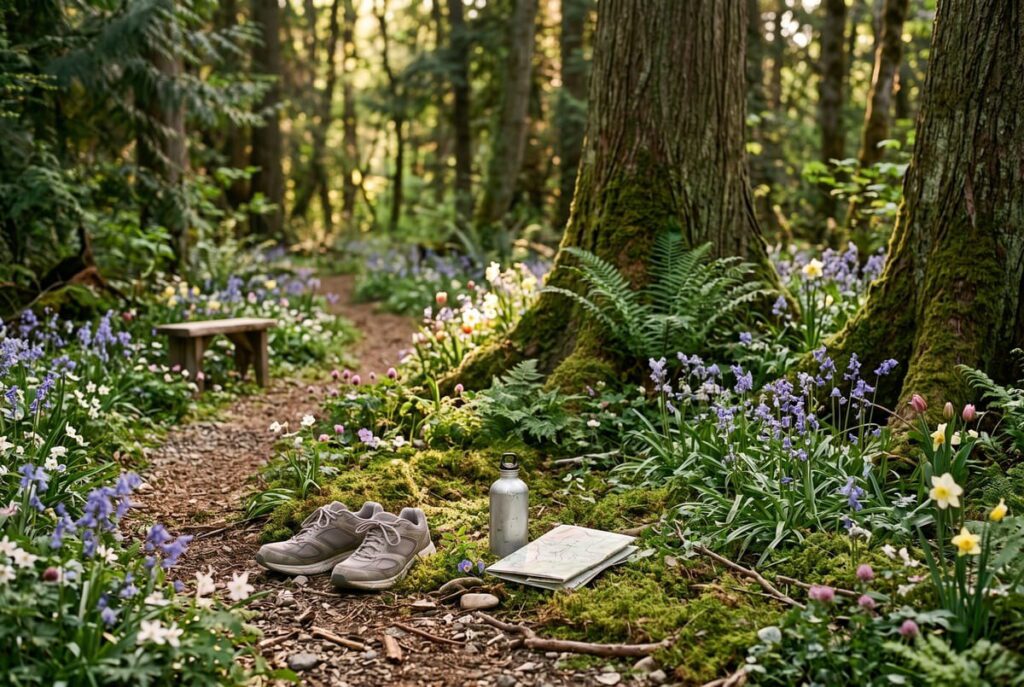
You genuinely don’t need much gear to start. Just comfortable shoes and something to carry water in, though “comfortable” and “supportive” aren’t always the same thing when it comes to shoes. I learned that one the hard way: very flat shoes are fine for a short walk, but rack up enough steps in them and your feet and calves will let you know about it. If you’re walking often, it’s worth spending a little more on real support. Bring some company along, it always makes things more enjoyable, or bring your dog if you have one. Or, if you’d rather, treat the whole walk as a rare, guilt-free stretch of solitude.
Turning a Stroll Into a Meditative Practice
Walking is a solid cardio habit, but it’s also something closer to meditation in motion. I first learned this properly at a yoga retreat on Bowen Island, just outside Vancouver, where part of the practice was walking meditation: walking as slowly as you possibly can and trying to sense absolutely everything around you.
Not just the obvious things, either:
- The trees, the grass, the water.
- The birds, the squirrels, the rocks.
- The exact temperature of the air, the wind on your skin, whatever you can smell.
When you actually pay attention to all of it, you start becoming more present, noticing things you’d normally miss because you were rushing straight past them.
Once that practice sticks, you’re not just walking to walk anymore. You start noticing things worth being grateful for, absorbing what’s actually around you instead of what’s in your head. It’s not really about the exercise at all. It’s a few minutes that belong entirely to you: your mind, your senses, whatever you need that day.
How to Start Your Walking Journey Today
You can start adding movement to your life today. If you’re not sure where to go, look up a local trail or a nearby park and just follow the path. If you’re more of a city person, try running your errands on foot instead of taking the car. Even a trip to the mall can turn into low-impact exercise if you choose to move through it with intention instead of rushing.
According to Better Health Channel, just 30 minutes of walking a day can raise your cardiovascular fitness, strengthen your bones, and help reduce excess body fat. And there’s a real physiological reason walking outside feels different from walking on a treadmill: multiple studies on time spent in green space have measured a genuine drop in cortisol, the hormone most responsible for that wound-up, can’t-settle feeling.
Walking When You’re Traveling
Travel is secretly one of the best ways to rack up steps without trying. I once hit 28,000 steps in a single day exploring Rome, wandering from morning until afternoon without really noticing the distance. I was exhausted by the end of it, that’s four times my usual daily number, but it proved something: we’re capable of a lot more than we think.
If you travel often, use it. Put the phone away for a stretch, get out of your own head, and just walk. Explore. That’s honestly a big part of what makes life feel good: having the time to go outside and actually notice things you’d otherwise walk right past.
Final Thoughts on Simple Movement
Whether you land on 3,000, 7,000, or 15,000 steps, the important part is starting and keeping it consistent. There’s no membership to cancel here, no one to report your numbers to. It’s a commitment you make with yourself, for yourself, which is exactly why it tends to stick when other things don’t.
We all need more movement in our lives, and too much time sitting is a real cost to long-term health. You don’t have to love the gym to be fit. Start with this low-impact exercise and see what it does for you over a few weeks.
If curating your movement has you thinking about curating other parts of your life too, I’ve got a guide on building an effortless spring capsule wardrobe that pairs nicely with all this new walking: comfortable enough for a stroll, put-together enough that you won’t think twice about it.
What would your days look like if movement felt less like a chore, and more like a few minutes that belonged only to you?